Official ticketsSeats together24/7 Support
Official tickets
Seats together
50k+ Happy Customers
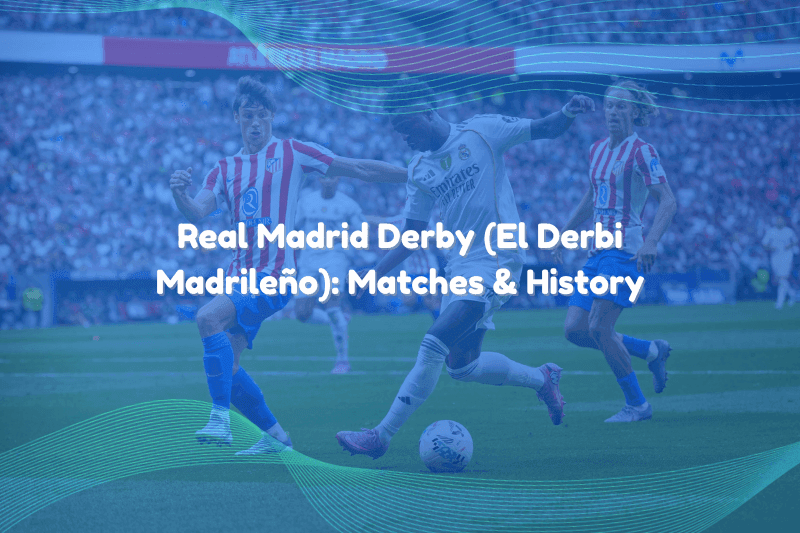
Explore the Real Madrid vs. Atlético rivalry. Get the latest match dates, legendary history, and key stats for the El Derbi Madrileño.
The footballing landscape of Madrid is not merely split by neighborhood boundaries; it is divided by two fundamentally incompatible worldviews. When Real Madrid and Atlético de Madrid meet, it is a structural, cultural, and philosophical clash that mirrors the historical dualities of Spain itself. A single capital city acts as the host to this eternal friction, where every square meter of public space becomes an ideological battleground. This is a rivalry that refuses to be generalized as a simple sporting contest.
The two clubs have come to represent pure, unadulterated sports archetypes that stand in total opposition to one another. Real Madrid is the global symbol of continental glamour, institutional majesty, and corporate royalty. The club operates on a mandate of absolute excellence, where victory is not just desired but structurally demanded as a natural right. Conversely, Atlético de Madrid has cultivated a proud, defiant identity as the collective underdog. Their sporting ethos is anchored in structured resistance, defensive solidarity, and a gritty, blue-collar resilience that views suffering as a necessary prerequisite to triumph.
What gives the Madrid Derby its unique, suffocating intensity is the inescapable proximity of the two fanbases. Unlike international rivalries where geographical distances separate the opposing factions, the citizens of Madrid live in a state of permanent coexistence. Colchoneros and Merengues share the exact same workplaces, sit at the same family dinner tables, travel on the same metro lines, and walk the same sun-drenched plazas.
The roots of this division stretch back to the infancy of organized Spanish football. Real Madrid, originally established as Madrid Foot Ball Club, quickly aligned itself with the city's upwardly mobile commercial, technical, and academic classes. The club was corporate from its inception, seeking grand stages and formal prestige.
In 1903, a group of Basque students living in the capital established an offshoot of their hometown club, creating Athletic Club Sucursal de Madrid. This entity eventually broke away to become an independent club, planting its roots firmly in the southern and western industrial corridors of the city. From these early decades, the foundations were laid: one club looked toward institutional expansion, while the other became the voice of the neighborhood.
The historical reality of the post-Civil War era challenges many oversimplified political narratives that have been retroactively applied to Spanish football. In the immediate aftermath of the conflict, it was actually Atlético that held the keys to institutional backing. Merging with the air force team, they became Atlético Aviación, a dominant power of the early 1940s backed by military personnel.
The true pivot point in the rivalry occurred during the presidency of Santiago Bernabéu. Taking over a devastated Real Madrid, Bernabéu pioneered a vision of global expansion. He oversaw the construction of the massive Chamartín stadium and actively signed world-class international talents, single-handedly transforming Real Madrid into the global face of Spanish sport and permanently altering the power balance of the capital.
Over the decades, the traditional rich north versus working-class south narrative has evolved from a literal geographic separation into a set of deeply internalized psychological frameworks. Today, you will find wealthy Atlético season ticket holders living in the affluent northern suburbs, just as you will find passionate Real Madrid fan clubs in the historically industrial southern belts like Vallecas or Getafe.
However, the institutional identities remain completely unchanged. Real Madrid continues to present itself as an elegant aristocracy, while Atlético fan culture prides itself on a heritage of grit, suffering, and passionate loyalty born out of historical marginalization.
To understand Real Madrid, one must understand the concept of Señorío, a term that blends nobility, sportsmanship, and an unyielding, regal expectation of success. The white uniform is treated as a royal garment that carries the burden of history.
The club has institutionalized the acquisition of the world's most elite individual talents. This strategy, born out of the original early 2000s Galácticos era under Florentino Pérez, has evolved into a highly sophisticated modern scouting and marketing network. The contemporary squad features a collection of global icons like Vinícius Júnior and Kylian Mbappé. These players are expected to provide moments of individual magic that can break open a tactical lock, reinforcing the club's belief that supreme talent will always conquer organized structure.
In December 2011, the return of Diego Simeone as manager sparked a sporting and psychological revolution that completely redefined modern Atlético de Madrid.
The tactical identity of Cholismo is built upon a foundation of defensive discipline. Atlético frequently deploys a compact low block or mid block structure, denying opposition attackers any space between the defensive lines. They bait the opposition forward before triggering explosive, vertical counterattacks. Every player is expected to press, tackle, and block with manic intensity.
This worldview is summed up by the philosophy of Partido a Partido, treating life and football not as a grand, long-term project, but as a series of isolated, immediate battles that must be won through sheer physical and psychological endurance.
This creates a magnificent, repeating tactical conflict on the pitch. It is a pure ideological war: Real Madrid's high-budget individual star reliance versus Atlético's high-intensity collective system adherence. Real Madrid relies on spatial creation, technical elegance, and rapid ball circulation to break down blocks. Atlético counters with physical suffocations, aggressive spatial denial, and targeted tactical fouls designed to break the rhythm of Real's expensive creators. It is luxury versus labor, played out over ninety minutes of high-tension football.
The middle of the twentieth century was an era of unprecedented continental dominance for Real Madrid. Led by icons like Alfredo Di Stéfano, Ferenc Puskás, and Paco Gento, the club captured the first five European Cups, establishing a standard of international prestige that left Atlético in its shadow.
Yet, within the borders of Spain, the domestic derbies remained remarkably fierce. Atlético, boasting legendary figures like Adrian Escudero and, later, Luis Aragonés, frequently functioned as the ultimate domestic speed bump, using their physical style to disrupt Real Madrid's smooth European machine in highly contested league matches.
Following Atlético’s painful relegation at the turn of the millennium, the club entered a dark, psychological black hole regarding the derby. For fourteen consecutive years across all competitions, Atlético failed to record a single victory over Real Madrid. This era was defined by bizarre tactical collapses, late Real Madrid winners, and a growing sense of fatalism among the Colchoneros support.
The curse was finally shattered in dramatic fashion during the 2013 Copa del Rey Final. Played inside Real Madrid's own stadium, the Santiago Bernabéu, Atlético fought back from an early deficit to secure a historic 2-1 extra time victory, a tactical and psychological breakthrough that completely cleared the mental scars of a generation.
The rivalry reached an unprecedented, historic peak when the two local enemies clashed on the grandest stage in world football: the UEFA Champions League Final.
In Lisbon, Atlético stood mere seconds away from capturing their first-ever European Cup thanks to a first-half goal from Diego Godín. Then, at exactly ninety-two minutes and forty-eight seconds, Sergio Ramos rose high to head home a dramatic equalizer from a corner kick. The moment shattered Atlético’s collective spirit.
Exhausted by their physical defensive exertions, Atlético collapsed in extra time, allowing Real Madrid to run away with a 4-1 victory to claim their legendary tenth European title (La Décima).
Two years later, the capital rivals met again in Milan for another European showcase. The match was a grueling, tactical war of attrition that ended in a 1-1 draw after ninety minutes and extra time. Yannick Carrasco's emotional equalizer for Atlético canceled out an early Sergio Ramos opener, forcing a penalty shootout.
Real Madrid displayed absolute calmness from the spot, converting all five penalties to secure another continental triumph, reinforcing the tragic hero narrative for Atlético while continuing Real Madrid's European monopoly.
In the seasons following those historic European nights, the derby has maintained its high-stakes intensity across domestic competitions. Atlético has exacted revenge by securing crucial league victories at their new home stadium, while Real Madrid has consistently leveraged its experience to edge out tight knockout fixtures in the Supercopa de España, ensuring that the domestic title race always passes through a capital city blockade.
The competitive history of the fixture spans over a century of official data. Real Madrid holds a significant historical advantage across all major competitions, though the modern era has seen the gap narrow significantly under consistent tactical structures.
Individual excellence has left an indelible mark on the statistical charts of this rivalry.
The current iteration of the derby features a fascinating chess match between Carlo Ancelotti's fluid, flexible structures and Diego Simeone's evolving mid-block variations.
Inside their newly enclosed stadium, Real Madrid utilizes vertical transition speed to devastating effect. The tactical approach centers on creating overloads on the left flank before rapidly switching play to isolate defenders. The midfield focuses on ball circulation control, waiting for the precise moment to exploit half spaces behind Atlético's midfield line, while relying on late-game physical resilience to overwhelm opponents.
When operating on their own turf, Atlético transforms into an aggressive pressing machine. Supported by a hostile crowd, they lock down central passing lanes and trap opposition fullbacks against the touchline. Simeone has integrated more ball possession structures into his modern setups, but the core defensive identity remains anchored in rapid penalty box defending and lethal set-piece delivery.
The domestic league campaign guarantees two high-intensity iterations of the derby each season. The scheduling of these matches is a critical factor in the development of the title race. The autumn iteration, usually held between September and November, functions as an early barometer of tactical readiness, exposing any structural flaws before the winter transfer window. The spring return fixture, falling between March and May, routinely carries massive implications for the destination of the championship, where a single slip-up can end a season's ambitions.
The modern calendar means that a single month can frequently feature a cluster of derby matches. Knockout pathways in the Copa del Rey often pit the capital rivals against each other in intense, two-legged ties or single elimination matches that push players to their physical limits. Furthermore, the expansion of the UEFA Champions League format increases the statistical probability of these cross-town enemies meeting in high-stakes European knockout rounds, adding immense mental pressure to an already overloaded competitive schedule.
Playing a derby away from home within your own city boundaries presents a unique logistical and tactical challenge. While travel fatigue is completely eliminated, the psychological environment shifts dramatically. Visiting squads must walk into stadiums where ninety-five percent of the crowd is intensely hostile. Statistical metrics indicate a clear drop in possession percentages and passing accuracy for both teams when performing as the away side in the derby, proving that stadium atmosphere directly influences tactical execution on the pitch.
The geography of fan celebration in Madrid is anchored by two historic fountains situated less than a kilometer apart along the Paseo del Prado, serving as symbolic thrones for the respective fanbases.
This beautiful square, featuring the eighteenth-century monument to the Roman goddess of nature, is the exclusive sanctuary of Real Madrid. When the club secures silverware, tens of thousands of fans pack the plaza, waiting for the team captain to climb the statue and drape a Real Madrid scarf around the neck of the goddess, a ritual that symbolizes global dominance and aristocratic triumph.
Atlético supporters gather around the fountain of the sea god Neptuno. Reclaimed by the fans in the mid 1980s to distance themselves from Real Madrid's celebrations, Neptuno represents the emotional home of the Colchoneros. The celebrations here are raw, passionate, and characterized by deeply emotional singing, framing their triumphs as hard-won victories against the establishment.
The physical arenas provide a stark contrast in fan culture and auditory intensity.
The Bernabéu operates much like a grand opera house. The crowd is highly demanding, analytical, and quick to express dissatisfaction if the football lacks technical elegance. However, following the recent installation of the retractable roof, the stadium acoustics have transformed. When the crowd roars in unison, the enclosed structure traps the sound, creating a deafening wave of noise that can completely disorient opposition communication during high-pressure defensive phases.
The Metropolitano is engineered to function as an intimidating cauldron. The stadium culture is defined by its relentless, organized chanting, led by the fanatical groups in the south stand. From the moment the team bus arrives outside the concourse, the environment is intensely partisan. The fans maintain their songs regardless of the scoreline, creating a wall of sound designed to lift their players through moments of physical exhaustion and unnerve the visiting squad.
The hours leading up to kickoff are defined by rigid, beautiful subcultures. Real Madrid fans traditionally gather along the streets surrounding the Calle Concha Espina, welcoming the team bus with massive smoke flares and historic chants. Atlético supporters coordinate massive fan marches from local neighborhood plazas toward the Metropolitano, singing old club anthems. Inside the grounds, both sets of fans deploy intricate, stadium-wide tifo displays that feature massive banners mockingly referencing historical matches, ensuring the psychological war begins long before the referee blows the whistle.
Ultimately, Real Madrid and Atlético de Madrid exist as an eternal mirror for one another. They are codependent institutions; the identity of one cannot truly exist without the defiance of the other. The global rise and financial power of Real Madrid has forced Atlético to refine its tactical structures to survive at the elite level.
In return, the relentless competitive threat posed by Atlético prevents Real Madrid from falling into complacency, ensuring that the capital city remains the absolute epicenter of footballing excellence. This local rivalry transcends the boundaries of sport, providing a spectacular, repeating showcase of human emotion, cultural pride, and ideological warfare that will continue to divide and define the city of Madrid for generations to come.
Are flight and hotel transfers included in standard football ticket packages?
Standard football tourism tickets do not include international flights or localized airport transfers within their entry-level configurations. Most travel operators sell stadium access as a standalone product or bundle it directly with local hotel accommodations situated near public transit lines. Travelers must organize their own airline logistics and utilize the city's efficient metro or express bus networks to navigate between the airport and their chosen lodging blocks.
What happens if the match date changes due to television broadcasting rights?
La Liga fixtures are assigned to a generic weekend slot when the season calendar is initially drawn up. The definitive day and kick-off time are locked in approximately three to five weeks prior to the match weekend. Matches can be scheduled anywhere from Friday night to Monday evening to maximize global television audiences. If a fixture shift occurs, tickets remain completely valid for the newly assigned date, and platforms do not provide financial compensation for schedule modifications.
Can children attend the match without a separate ticket purchase?
Every single person entering the stadium complex must possess an individual ticket with a specific designated seat assignment, regardless of age. Spanish stadium safety laws and public entry regulations do not allow parents to carry infants or young children past the turnstiles without valid individual documentation. The clubs do not provide discounted youth or toddler pricing tiers for high-demand fixtures like the derby, meaning standard admission rates apply.
Is it safe for neutral or visiting fans to sit in the domestic longside sections?
The general longside seating sectors at both the Bernabéu and the Metropolitano are highly civilized, commercial environments where international neutrals can sit safely. However, visiting supporters must refrain from wearing away team jerseys, scarves, or hats within these home areas. Displaying opposing club colors in home fan sectors can lead to verbal arguments with local season ticket holders and will result in immediate intervention by stadium stewards who may eject you for crowd control safety.
How are e-tickets delivered, and what should I do if my phone battery dies at the turnstile?
Modern tickets are issued digitally as secure mobile passes or encrypted barcodes sent via email days before the match occurs. These digital passes must be downloaded onto a smartphone device. If your phone battery fails outside the gates, you must locate the stadium box office resolution windows. By presenting your official physical passport and purchase verification emails, the support staff can access the database to cancel the failed digital pass and print out a physical entry slip.
We made dreams ..
come true
We’ve helped hunders of football fans to experience their football journeys to the fullest, and we are extremely proud of that!


We made dreams ..
come true
Recommended by 99%
Show all 164 reviewsWe’ve helped hunders of football fans to experience their football journeys to the fullest, and we are extremely proud of that!
Recommended by 99%
Show all 164 reviews